The inhabited city
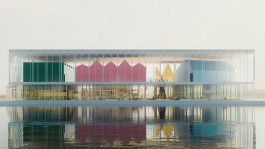
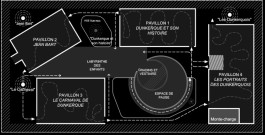
The spatial organization of the project revolves around the positioning of the exhibition pavilions on the first floor. These pavilions extend to the ground floor to accommodate the entrance programs: hall, café, library, performance space, administration, and artwork logistics.
The architectural envelope unfolds around these various entities, creating a variety of social spaces between the programs.
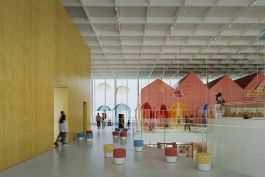
Designed as a porous place, open to all rhythms of visits and all uses, the project draws inspiration from the inhabited city: traversable, welcoming, and conducive to exploration. The circulations are multiple, intersecting, and free. They encourage the coexistence of diverse audiences, the convergence of temporalities, and the emergence of singular pathways.
Visual porosities
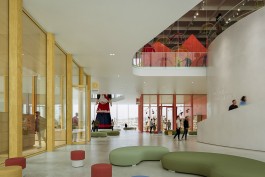
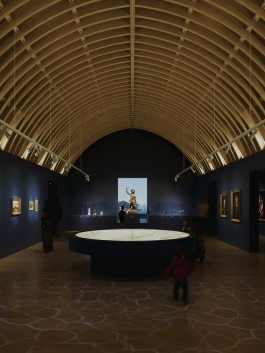
Skylights connect the levels. The first one showcases a giant figure, an emblematic symbol of the Carnival and dear to the people of Dunkirk. The second skylight, used by visitors, takes the form of a grand staircase spiraling around the performance space and leading to the first floor.
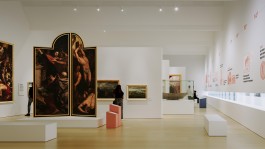
Four pavilions, four identities
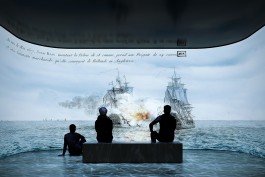
Each pavilion has a strong identity, both externally and internally. Each is distinguished by its own color on the façade and a specific roof typology, offering a variety of atmospheres and interior scenographic possibilities.
Between modularity and immersion
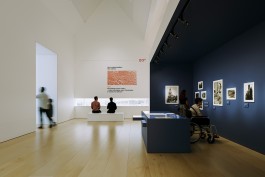
The four pavilions share cross-cutting scenographic principles, ensuring coherence, visitor comfort, and adaptability.
The scenographic furniture is designed to adapt to the diversity of artwork formats.
The Children’s Labyrinth
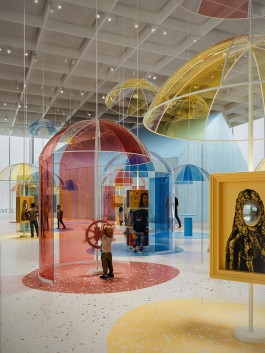
The "Children’s Labyrinth" is an innovative and captivating space specifically designed for children under 11 years old.
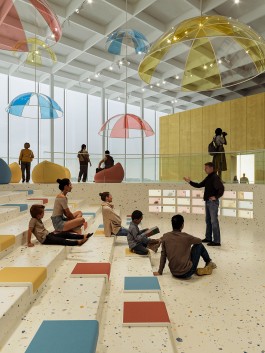
This labyrinth, located in the interstices between the museum’s thematic rooms, aims to be an immersive public space where children can explore art through their senses. This unique space is characterized by colorful, transparent suspended umbrellas and colored circles on the floor, creating a magical and playful atmosphere.
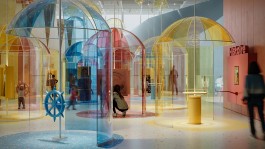
A colored transparent partition, like a screen, creates intimacy for each interactive installation, inviting children to discover and engage with various artistic devices. Against the walls, display cases host installations linked to the theme of the corresponding room.